A Night with the Shepherds of West Sikkim

Updated: Jun 11
The Search
After a three-hour drive and another hour of walking, we were told that if we wanted to meet the herders, we would probably need to rent a vehicle, as they were quite far away. After a quick packet of Wai-Wai noodles, we rushed to the next village to look for one. Our race was against the sun. Once the sun set, we were told, the herders would pack up.
As luck would have it, we found the herders on our way to the village at Rhunghtum. They were camping there. The three herders we came across were from the Gurung community of West Sikkim. The group consisted of a senior herder and two helpers, all from the same community and the same village, Nakargol. With them were around 200 sheep. While most of the herd belonged to the three of them, they said a few animals belonged to friends and neighbours from the same village.
Walking with the Herd
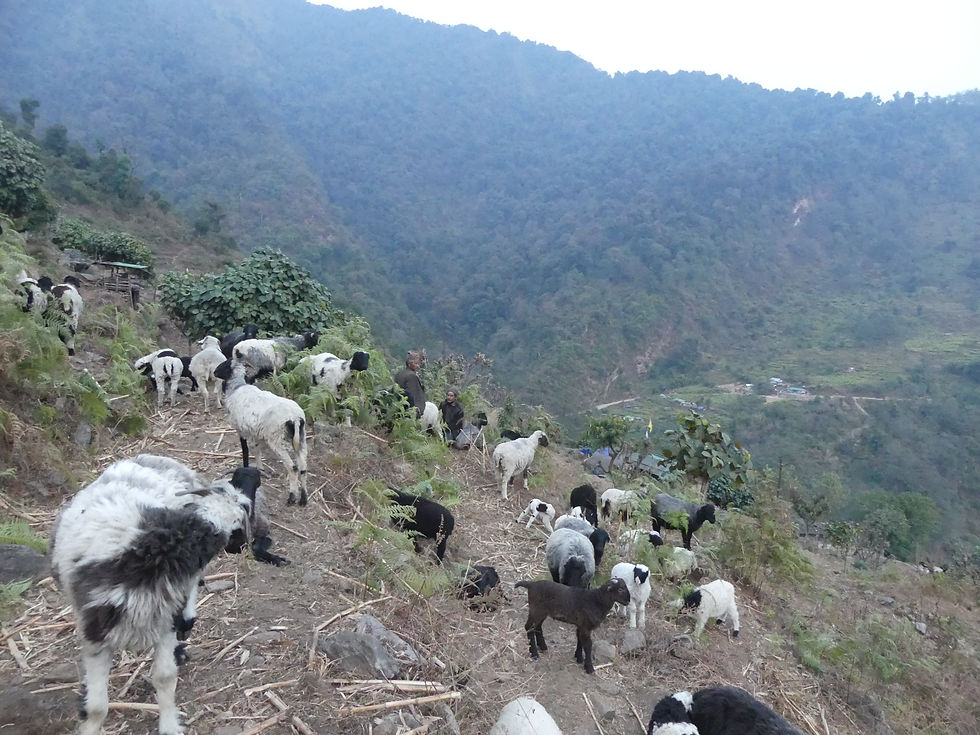
Pulling out our cameras, we walked up with the herders and their sheep; it was hard not to notice each sheep's individuality and their differing relationship with their herder.

A three-day-old newborn who refused to get up
There was the newborn, only three days old, who refused to get up, despite our efforts to pick it up; it went back to sit in its position. Another lamb, just a day older, kept getting stuck in the thorns and crying. Some sheep hardly budged unless they heard from their herder, while others almost galloped ahead, and some seemed to just enjoy their hooves creating the dust when stomped.
The herd closing around the goth at dusk
White, grey, brown: each of these shades with their customised patterns surrounded us from all sides. While some ran away from us and our cameras, others almost seemed to be posing for us.
The herders seemed to know every one of them.
“Black sheep move together, spotted ones cluster separately. Sometimes those born in the same year stay together as a group. We count them two or three times,” one of the herders said when we asked how he keeps track of this large group that seemed to wander off in different directions.
The Dera at Dusk
By dusk, the herders began retreating to their dera, the temporary dwelling where they rest for the night.
The dera is a waterproof blue tarpaulin sheet stretched between wooden poles and anchored by large stones driven into the ground. Inside, the floor is lined with fern leaves so the earth does not feel damp or cold for the humans, their accompanying dog and the keri, the leader of the herd, who occasionally seemed to rest inside.

Keri, the herd's designated leader, resting inside the goth with the herders
Partially covered on one side and open on the other three, the dera held a quiet warmth against the evening cold.
The younger herder started the fire and brewed tea. Smoke and heat filled the space as ash drifted upward, almost forming a soft filter over the background, as we were shown the kukri (a kind of knife) and the various displays made from sheep, yak wool and bamboo decorating the dera.
Meanwhile, goat milk was taken from a plastic vessel where it was stored, and a generous amount was added to the tea before it was handed to us.
As we finished our tea, we were called to see how the sheep were milked.

Gurung herders milking a sheep at the evening round
The daily milking of the sheep was done twice. Two herders with their glistening golden boots, slowly approached a lactating mother sheep from the front and back, startling her into stillness with sudden movements. Once they catch hold of her, the herder at the back squats and squirts the milk into a bamboo bucket called a dheeri. This is done twice a day - mornings and evenings.
When we asked how they knew which sheep to milk, the herders replied with a smile: “We know because we are herders.”
If saliva drips or breathing changes, they know something is wrong. Sometimes they take the sheep to a veterinarian, but often they rely on what they know: salt, mustard oil, sugar, and even hemp leaves when the sheep have loose stools. Sometimes it works. Sometimes it does not. If the sheep die from a disease, they cannot be eaten; they must be buried properly to prevent the illness from spreading.
Around the Fire
As night settled, the fire glowed within the stone square of the gang (fireplace). Seeming to have a personality of its own, it crackled and sputtered, sending streams of ash and smoke toward our faces whenever our attention drifted elsewhere.
Inside the dera, more people gathered. Friends from the nearby village joined the three herders, and two of their wives came to see us.

Around the fire inside the goth, late into the night
Soon, Ramesh da, our field staff who had disappeared after tea, arrived carrying a nati kori (local hen) for dinner. As the ingredients were skilfully prepared, conversations moved between land, identity, and the future of pastoralism. The herders spoke about how once their herds numbered around 1,200 sheep and goats, but now they manage about 200. During that time, families would divide their herds and move in different directions across the mountains. The landscape was wide enough then, and grazing could be spread across the land.
The herders discussed how it was first the Gurung people who started keeping sheep and goats, then the Mangar people followed and got very good at it. Today, it is mainly these two communities that continue the practice of sheep herding.
“No matter who keeps the animal, you need to respect the animal. Now the respect has gone down,” said one of the herders softly.
Tradition, here, is not abstract doctrine but repetition across generations: what ancestors wore, fed, sacrificed, and tended.
“Our Livestock are our companions, but they are also food and give us warmth.” The senior herder said as he proudly showed a sweater knitted by his wife. It was made from the wool of their own sheep and was called lukuni. He also pointed to the rugs made from sheep wool and small knitted wool patches used as mittens for lifting hot vessels.
When asked about their beliefs, the herders said they believe in one entity. They do not know whether it is a god or a demon, but each year they offer one sheep to it, saying, “This is yours,” before later sharing and eating the animal.
During festivals such as Dashain and Tihar, sheep fetch high prices. The group discussed how everything has gotten expensive. Salt that once cost ten rupees now costs nearly ₹500–600 per bora. A sheep that once sold for ₹60 or ₹70 in his youth now sells for thousands.
Once a week, the herd of 200 animals consume about seven kilograms of salt; they hire someone from the village to carry the salt and other supplies when they shift goths (camps). Without salt, the sheep begin eating soil. “We don’t know exactly what salt does; maybe it makes them tastier. It’s like us, without salt, even ghee doesn’t taste good.”
After intensive preparation, the aroma of the chicken filled the dera. Cameras and books were shut as we prepared to eat. The conversation soon evolved to how, while families now experiment with poultry farming or cultivate cardamom as a cash crop, pastoralism remains important. During festivals, family gatherings, or times of scarcity, sheep sustain the household here. They also noted that fewer sheep are dying now compared to a few years ago, which they see as a sign that pastoralism is slowly being revived.
Outside, the herd huddled in groups, lambs close to their mothers like glowing cotton balls in the moonlight. The faraway lights from the houses blended with the stars until it was hard to tell which was which.
The Midnight Routine
At around 11 pm, the herders went out again to gather the sheep who had decided it was time to snack again, part of their nightly routine. The mountains had grown quiet except for the occasional rustle of hooves, distant cries of the sheep and the occasional grunt of the dog.
Inside the dera, the fire burned slowly as conversations faded into the night.
Government policies have tightened here over the past few decades. Grazing bans, fenced lands, restricted grazing rights, and even bans on taking herding dogs into higher pastures have shrunk the spaces where herders can move with their animals freely.
The mountains themselves were said to be different: ice has receded, rivers have thinned, and grass that once grew two feet high now barely reaches one, leaving the sheep weaker than before. And with the ban on dogs, they are more prone to attacks from predators.
“Our people will never leave it. Our lives are synced with our sheep,” said one of the herders as he lay down to sleep.
Morning
By the time we reached the dera the next morning, the day had already begun.
Tea was served, and a neighbourhood child had wandered into the camp. After a quick meal made from the previous night’s leftovers and after insisting that we wash our own utensils, we spent some time with the sheep and their human companions before the herding began again.

Milk is being churned at the morning camp
Soon, someone called out asking if we wanted to see how the milk was churned. Excited, we took over the task, only to realise after ten minutes that the milk had already been churned and we had simply been called to be shown.
After another round of milking, the sheep was slowly called out. Soon, the younger herder started walking ahead, followed closely by the keri. Behind them came the rest of the herd. The senior herder walked behind the herd. When the youngest lamb, crying as it tried to find its mother, got stuck in the thorn bushes, he patiently freed her with his kukri.
Slowly, the herd moved forward into the mountains. After they left the herd to graze, the herders came back around 11 am.
After some more conversations, we prepared to leave, and someone suggested taking a group photo. One of the herders paused and said, “Wait, we need to wear our lukuni
(jackets made from sheep wool). We are herders, no?” He passed them around, and the others slipped them on before gathering together for the picture.
Acknowledgement
I would like to express my sincere gratitude to my colleagues, Wilson Biswakarma and Ramesh Chettri, who accompanied me during our fieldwork in West Sikkim and assisted with translation from Nepali to Hindi, greatly facilitating our interactions in the field. I would also like to sincerely thank the Gurung herders for their generous hospitality and for welcoming and feeding us during our stay. I am especially grateful to Dr. Rashmi Singh for her constant guidance, encouragement, and unwavering support throughout the fieldwork.
About the Author

Anjali Joy is a storyteller and researcher with a background in architecture, environment, and development. Her work explores how people, animals, materials, and landscapes shape one another across changing socio-ecological systems.


Comments